


Advancing Sustainability with Architectural Glass: A Guide to LEED v5 Credits
Devin Bowman, General Manager, Technical Glass Products & Aaron Owens, Sustainability Specialist, Allegion
Environmental stewardship has been a growing priority in building construction, driving the widespread adoption of green building certifications that help standardize and measure sustainability efforts. One of the most recognized is the U.S. Green Building Council’s (USGBC) Leadership in Energy and Environmental Design (LEED) program, which now includes more than 197,000 certified projects across 186 countries, covering nearly 29 billion square feet.
In April 2025, the USGBC released LEED v5, its most transformative version to date. It marks a decisive shift toward performance-based, carbon-conscious design. The framework’s latest evolution places heavier emphasis on three key areas of impact: decarbonization, quality of life and ecological conservation and restoration. Unlike previous versions, where energy efficiency and carbon emission were often combined into one credit, LEED v5 makes carbon, climate resilience and social equity assessments prerequisites part of every project pursuing certification. The evaluation and consideration start from the earliest phases of project planning. The shift underscores the importance of solutions that not only improve energy efficiency but also enhance occupant well-being and environmental performance. There is also increased focus on product transparency.
Glazing solutions from Technical Glass Products (TGP) can serve as a powerful tool for design teams, helping them achieve the objectives outlined under LEED v5. By optimizing daylight, improving occupant experience, reducing air leakage and lowering operational energy use, advanced curtain wall and window systems support designs that are high-performing, occupant-centered and conducive to LEED v5 credit attainment.
Integrative Process (IP)
From the earliest design discussions, TGP’s glazing systems can help teams meet the Integrative Process Human Impact Assessment prerequisite (IPp2), which includes assessing occupant experience. This, now mandatory prerequisite in the Integrative Process, Planning, and Assessments Category, encourages early collaboration of the design team to analyze and plan for the interrelationships among various systems. This helps collaboratively address decarbonization, quality of life, and ecological conservation and restoration across the entire LEED rating system. Such efforts can include considering how glazing affects energy loads, thermal comfort and daylight levels.
For example, in curtain wall solutions like TGP’s SteelBuilt Curtainwall System, steel plays a key role in achieving a high-performance outcome. The material’s strength enables leaner frames to support larger spans of glass, leading to more expansive curtain wall designs. By integrating such a system into their designs, teams can maximize daylight and create a more seamless connection between interior and exterior spaces, all of which benefit the occupant experience.
Designers can also use glass lites with low-emissivity (low-E) coatings to improve thermal performance, reducing solar heat gain. Computer simulations of steel curtain walls, based on NFRC 100 procedures and using 1-inch insulating glass units with clear low-E coatings, showed U-values of 0.29 to 0.39 Btu per hour per square foot per degree Fahrenheit. This highlights steel-framed glass curtain wall’s performance in resisting heat transfer.
Additionally, steel framed curtain walls can help mitigate heat transfer between spaces. Steel’s thermal conductivity is roughly 74 percent lower than aluminum at around 31 BTUs per hour. The performance is comparable to thermally broken aluminum frames. Some advanced steel profiles don’t even require a traditional thermal break, using less metal to support glazing and reduce heat transfer.
These attributes allow design teams to count on glazing systems when conducting early energy analysis, maximizing daylight and controlling solar heat gain. In turn, they are one step closer to fulfilling the Carbon Assessment (IPp3) and Integrative Design Process (IPc1) requirements under the Integrative Process category.
Indoor Environmental Quality (EQ)
Steel framed glass curtain walls can also contribute significantly towards credits under the Indoor Environmental Quality (EQ) category. Large, uninterrupted spans of glazing bring the outdoors inside, providing views that support occupant well-being and promote natural circadian alignment. Providing building occupants in the building with a view to the outdoor natural or urban environment for 75 to 90 percent of all regularly occupied floor area can earn project teams up to three points under Option 1, Path 2: Quality Views, within the Occupant Experience (EQc2) category.
TGP’s glazing solutions can also be designed to improve interior acoustics by reducing external noise intrusion. This supports up to two points under Option 4: Sound Environment, another pathway within EQc2. Curtain wall assemblies that incorporate laminated or double-glazed units, paired with thermal breaks and precise air sealing, can serve as effective sound barriers, helping limit the transmission of unwanted noise from surrounding urban or transportation environments.
By integrating these systems early in the design process, teams can create spaces that are both high-performing and human-centered.
Energy & Atmosphere (EA)
Optimizing energy efficiency is fundamental to LEED. This is highlighted in Energy and Atmosphere (EA) category. TGP’s product lines can contribute to meeting the requirements in multiple categories under this credit. For example, when tested to ASTM E283, Standard Test Method for Determining Rate of Air Leakage Through Exterior Windows, Skylights, Curtain Walls, and Doors Under Specified Pressure Differences Across the Specimen at a pressure differential of 6.24 pounds per square foot, TGP’s steel curtain wall systems have consistently measured air leakage at 0.01 cubic feet per minute per square foot or less. This performance comes from front-facing gasketing that isolates steel from air in the glazing channel, plus careful perimeter detailing and selective infill panels. The result is an almost impenetrable barrier against air and water, which reduces the load on HVAC systems and helps maintain consistent indoor comfort.
As mentioned earlier, TGP’s glazing systems can be manufactured with high-performance insulated glass units (IGUs) and low-E coatings to help reduce heat transfer, reduce air leakage and improve overall building performance. Additionally, steel’s inherent strength makes SteelBuilt Curtainwall Systems with heavy triple- and quadruple-glazed units, with glazing infills up to 3 in. thick and weights up to 23 lb/sf possible. This structural capacity enables designers to easily incorporate high-performing glazing systems that significantly boost a building’s thermal efficiency while maintaining sleek, narrower sightlines.
Computer simulations following NFRC 100 procedures reinforce this performance advantage. When modeled with clear glass and non-gassed airspace in triple-glazed IGUs, steel framed glass curtain walls achieved U-values as low as 0.19 Btu/h·ft²·°F. This capability rivals or exceeds many conventional systems. It is important to note actual results will vary depending on the specific glass and frame combinations selected for each project.
These high-performing glazing systems meet the U.S. Department of Energy’s definition for spectrally selective glazing, helping design team reduce energy consumption. Together, these performance capabilities can contribute to design teams meeting the mandatory Minimum Energy Efficiency prerequisite (EAp2) as well as earn up to five points within the Reduce Peak Thermal Loads (EAc2) category and up to 10 points under the Enhanced Energy Efficiency (EAc3) category.
Materials and Resources (MR)
Transparency is at the heart of LEED v5’s Materials and Resources (MR) category, which encourages design teams to make informed choices about the environmental and health impacts of the products they specify. Under the Building Product Selection and Procurement (MRc4) credit, teams are rewarded up to five points for providing clear, verifiable data on a product’s life cycle performance and material composition.
TGP makes achieving this credit easier by offering comprehensive documentation, including Environmental Product Declarations (EPDs) and material ingredient reports like Declare Labels or Health Product Declarations (HPDs). These support the new Multi-Attribute Score (MAS) calculations introduced in LEED v5. Several of TGP’s products qualify for a 2x MAS multiplier, meaning each product can count twice toward the quantity or value of required products when both environmental and material transparency documents are available. This applies to several of TGP’s high-performance systems, including the Fireframes® Curtainwall Series, Fireframes® Aluminum Series, Fireframes® Designer Series, SmokeSafe™ Window & Door and TGProtect™ FR System with IGU products.
By specifying these systems, project teams can streamline documentation, simplify credit tracking and demonstrate a strong commitment to environmental responsibility and occupant health, key principles at the core of LEED v5. This dual transparency approach also demonstrates TGP’s commitment to support the program’s broader goal of encouraging responsible sourcing and sustainable manufacturing practices.
Sustainable Sites (SS)
Protecting local ecosystems and biodiversity is a growing priority under LEED v5’s Sustainable Sites (SS) category. One of the ways that projects can contribute to this effort is by incorporating bird-friendly glazing that reduces the risk of bird collisions while maintaining daylight and aesthetic goals. Such projects can receive up to one credit under Biodiverse Habitat’s (SSc1) Option 2: Bird-Friendly Glass credit.
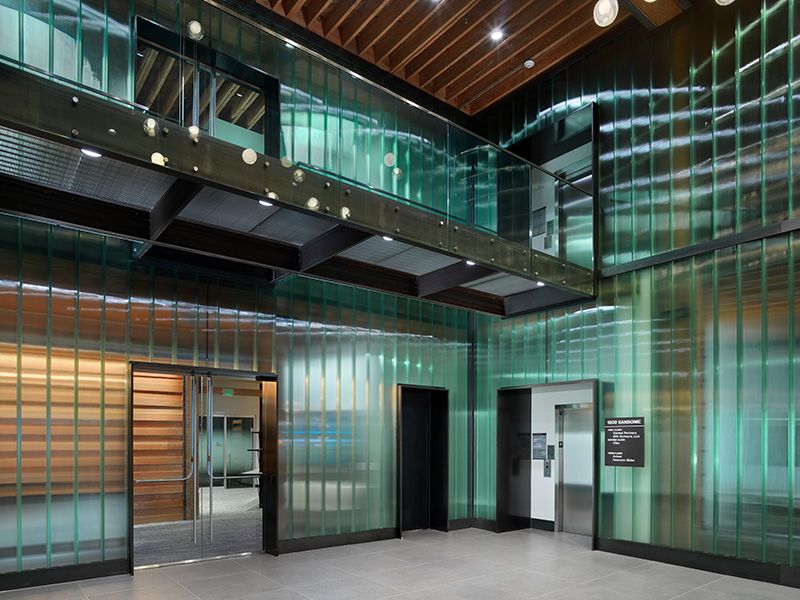
TGP’s Pilkington Profilit™ channel glass system offers an excellent solution for achieving this goal. Featuring a distinctive cast “orange peel” or linear texture, the glass diffuses reflections and improves visual contrast on the exterior façade. This characteristic helps birds recognize the surface as a solid barrier. As a result, the system has received a threat factor score of 10 from the American Bird Conservancy (ABC), indicating a low collision risk and high bird safety performance.
On the interior, TGP’s channel glass systems enable projects to improve U-values (as low as 0.23), solar heat gain coefficients and even increase sound transmission class (up to 44dB) ratings. Architects and design teams can use thermally broken frames or aerogel insulation in the air cavity of a dual-glazed channel glass system to further fortify thermal performance in projects where heat gain or loss is a concern, but daylight transfer is a priority.
Our team is ready to provide the documentation, performance data and design support you need to specify TGP products confidently for your next LEED project. Connect with your local territory manager or contact us.
Architect: Lundberg Design & MacCracken Architects
Photographer: Rien Van Rijthoven
 Aaron Owens, LEED® Green Associate™, CDT, DHT, DHC is the Product Sustainability Specialist at Allegion with over 14 years of experience. During some of those years, he managed and wrote door hardware specifications for projects across the United States and internationally.


