


Glass Elevates Airport Architecture to Cruising Altitude
David Vermeulen, North America Sales Director, Technical Glass Products
Despite being a transitory experience for most, airport architecture plays a crucial role in shaping not only how comfortable travelers are but also the very functionality of the built environment. For instance, interiors designed to be intuitively navigable can reduce the stress some people experience trying to make it to their gate on time. Likewise, access to daylight can help long-distance travelers more quickly adjust to changes in time zones by supporting circadian rhythms. Further, well-insulated façades can help to efficiently maintain a comfortable indoor environment, both in terms of temperature and sound attenuation.
For these examples (and many others), glazing systems for airport terminals can support designs that prioritize visual connection, daylight and comfort without compromising movement control and traveler safety. When project teams include the right glazing systems, airport architecture can do more than foster intermediate connections, it can become a destination in itself, as the following four projects demonstrate.
Airport architecture benefits from glass curtain walls
In terms of glazing systems for airport terminals, glass curtain walls are perhaps the most recognizable and commonly utilized assemblies. These glass systems can be specified for exteriors to help facilitate light transfer and connection to the surrounding landscape. They can also be used within an airport terminal to allow the deep penetration of light and to control access without diminishing visual connection between an airport’s entrance and its terminals.
Both usage types support a terminal expansion at the Will Rogers World Airport. The project team created a bowed glass façade using high-performance glazing held within narrow-profile steel frames. They continued this aesthetic inside the terminal by planning a transparent security barrier with the same steel frames, the SteelBuilt Curtainwall Infinity™ System from Technical Glass Products (TGP). Both assemblies combined steel’s strength with structural elements of the airport’s architecture to allow large spans and expansive glazing areas. These glass curtain wall systems contribute to a sleek and modern design that will help the airport remain a global hub.
Another glazing system for airport terminal design
In addition to glass curtain walls, airport architecture glass designs can include channel glass systems, which combine U-shaped glazing channels with an extruded metal perimeter frame. Because glazing channels can diffuse daylight or be backlit to create ambient textures within a building, they can add visual interest to an airport.
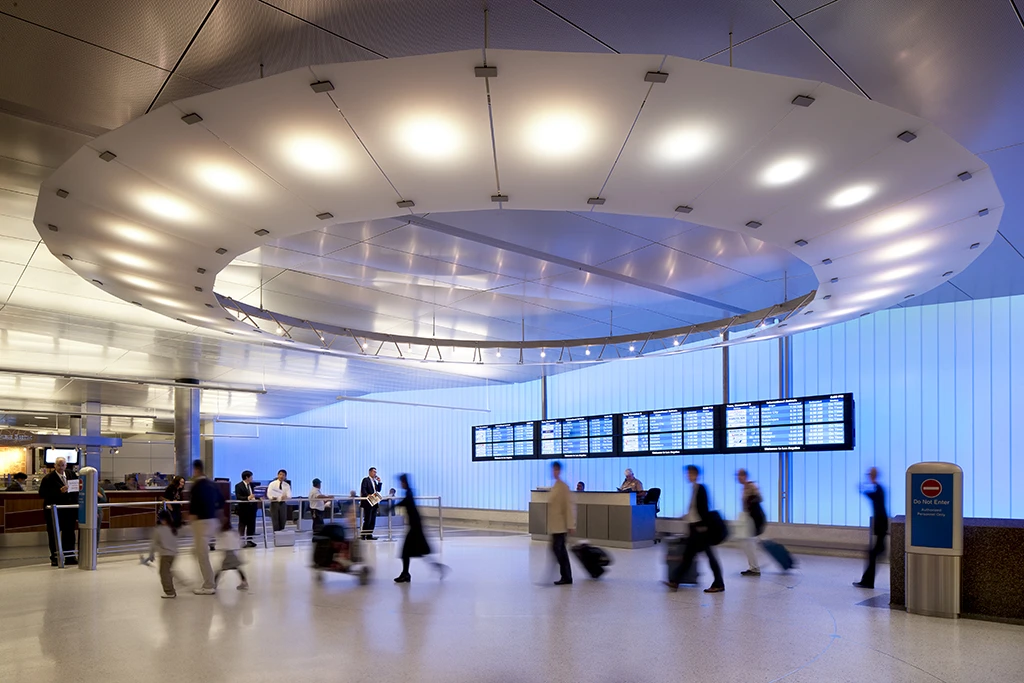
The Tom Bradley International Terminal in the Los Angeles International Airport (LAX) includes glass wall panels that extend from the arrivals to the greeting center. Using backlit Pilkington Profilit™ cast-glass panels, the airport’s interior architecture reflects the city’s entertainment-based culture.
While LAX uses an interior application, the glazing channels can support façade design as well. Channel glass can offer U-values as low as 0.19 and hurricane ratings for long-term resilience without significantly reducing daylight access, making them ideal for sustainable airport architecture.
For airport architecture, glass design can be functional and decorative
Design teams can also use glass to create more functional and safe environments. While non-rated systems can contribute access control and daylighting—as demonstrated at Will Rogers World Airport—fire-rated glass offers a complementary solution for achieving code compliance in protected areas. In fact, the passenger terminal subway cars at the Seattle-Tacoma International Airport (Sea-Tac Airport) incorporate FireLite Plus®, a fire-rated glass ceramic, to support visual connection as passengers shuffle between terminals.
But glazing can also be used to facilitate a modern aesthetic. For instance, the Dallas Love Field Airport uses Neopariés® crystallized glass panels for the exterior and interior surrounding the automatic doors in the ticketing and baggage claim areas. This glazing system provides a smooth, reflective surface that is resistant to staining, pollution and graffiti. It supports a brighter interior while minimizing maintenance and cleaning labor.
More than airport architecture: glass drives value in transit centers
Beyond improving airport architecture, glass designs can support project goals for other types of civic architecture, such as transit hubs. For instance, the Vaughan Metropolitan Centre (VMC) Subway Station in Toronto, Ontario, incorporates multiple glazing systems to strike a balance between being visually connected to the city and resisting the location’s extreme winter conditions.
Further, the Fulton Center maintains a cohesive design aesthetic between levels with matched systems. The hub’s fire-rated and non-rated framing systems use narrow-profile steel mullions to offer a close visual match—a crucial detail to obtaining the project team’s vision of the space.
Whether a design aims to show travelers where they are headed or give a glimpse of the city’s culture, glazing can support architecture that is occupant-focused, functional and beautiful. Flip through TGP’s digital look book to find inspiration for your next project.
 David Vermeulen is North America Sales Director for Technical Glass Products and also the author of the Fired Up blog on Glass Magazine.


